Introduction: Let the Rhythm Move You
Picture a soothing evening in a small Colombian town square. A flash of light can be seen
hanging above, the bass rhythm is slow, and people dance on the cobbles in time with each
other. The music? Infectious. The vibe? Electric. It is with much honour that I introduce cumbia
dance, a beautiful style in Latin America that represents the spirit of the dancing soul.
Cumbia is hard to overlook, whether live at a festival, playing at a party, or shared on social
networks. The lively beat, the lavish oriental-like costumes, and the graceful swirling of the
ladies assure that it is not just a dance but a celebration of the culture.
Well, here I present this guide, which explains the entire concept of Cumbia dance, from its
history to the movements. This is your starting point if you are interested in Latin American
dances or adding some spice to your playlists and party moves.
Let’s move to the beat.
What Is Cumbia Dance?
Cumbia is a Latin American folk dance that was born in Colombia. Similar to other dances, it
has rhythm and well-developed footwork and patterns. Its romantic couple movements are a
striking feature. Traditionally, it is performed in pairs, with the female dancer performing a
circular movement more often around the male dancer.
That is where Cumbia differs: it is an overt act of fusion with Afromodern electronic music,
African drums, Indigenous flutes, and Spanish motifs. This is not just about dancing; it is a total
feeling. It consists of distinct African drums, Indigenous flutes, and Spanish rhymes. Cumbia is
not just a dance; it is a show, a theatre production, and it draws emotions out of people.
Presently, Cumbia has crossed the boundaries of Latin America and beyond. It has, therefore,
expanded from the traditional style of music and dance to become associated with Mexican
music and other countries such as Argentina, Peru, and even the United States.
History and Origin of Cumbia
Like any other musical genre, cumbia has its background, originating in Colombia’s Caribbean
coast, particularly in the early colonial period. It originated from the mixture of three aggregates:
● Africans, who were enslaved and brought drums & rhythmic movements.
● Organizers of Indigenous people contributed flutes and other indigenous musical
instruments.
● Spanish colonizers, who introduced stringed instruments and European melodies
Cumbia was initially a courtship dance, with men chasing women slowly, flowingly, replicating
flirtation. The dancers wore traditional attire: long skirts for ladies and white clothes for men with
red scarves.
Cumbia dance expanded from Colombia to other regional countries and mingled with
intermediate instruments, languages, and dance. Especially in the twentieth century, it became
associated with nationalism and pride in the Colombian nation.
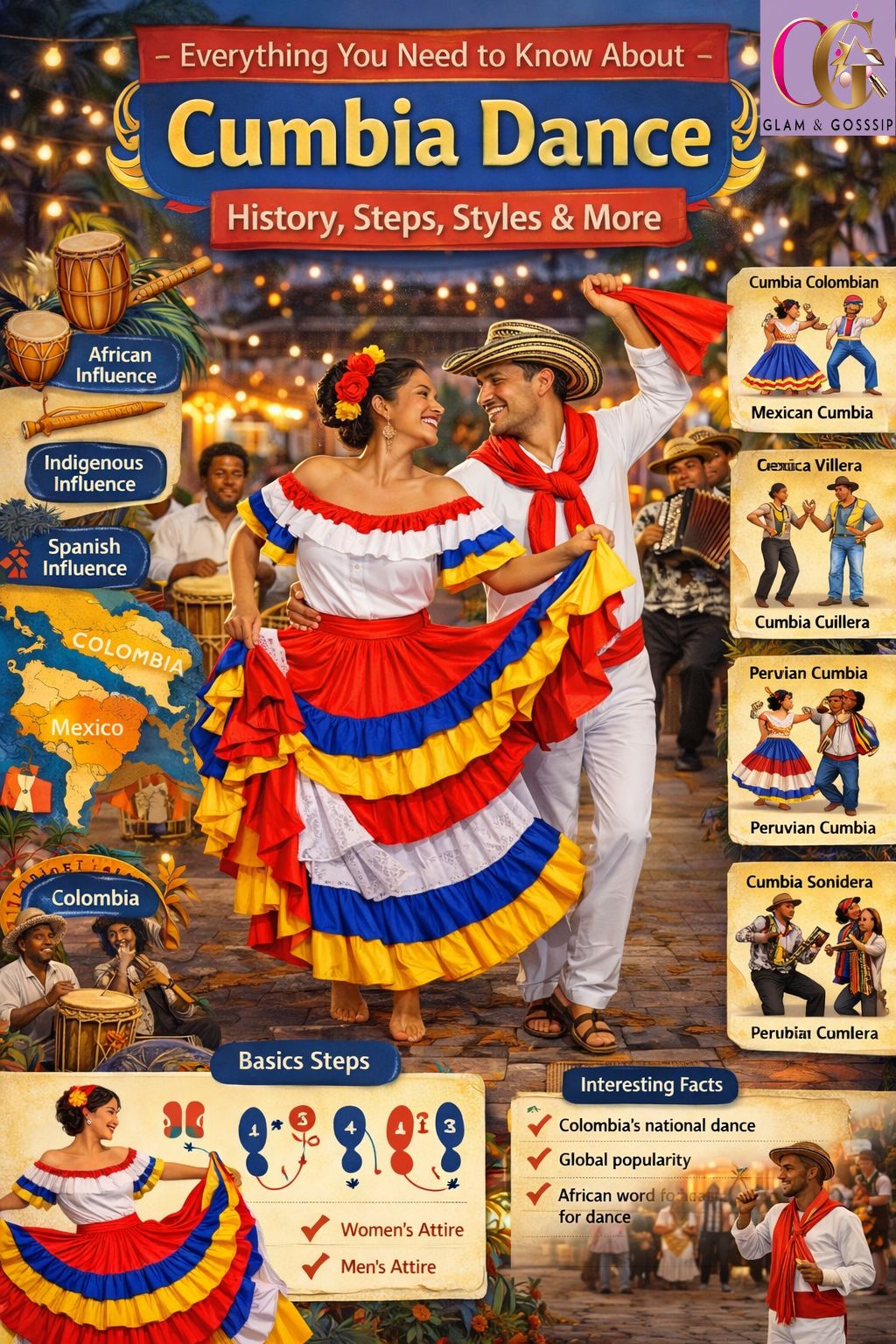
Today, there are various forms of Cumbia, and each one may be associated with a particular
region. Its influence is seen worldwide throughout Latin America and Latino communities, from
street parties to major festivals.
Different Types of Cumbia Dance
Cumbia dance continued to spread across Latin America; it started developing local subgenres
in its regional styles. Below are some of the common forms:
Traditional Colombian Cumbia
This is the original form. It is slower and more symbolic, and it is played on native instruments
such as the gaita flute and Tambora drum. Female dancers often hold candles in their hands
during performances.
Mexican Cumbia
This version has a faster tempo, electronic sounds incorporated, and is overall more cheerful
than the previous version. It is widely popular at social gatherings such as parties and dances in
Mexico.
Cumbia Villera (Argentina)
Cumbia Villera is danced in some of Argentina’s big cities. This dance style has a relatively raw
tune and is related to the urban working class. Many of the songs are poetic in content and have
undertones of social and political messages.
Cumbia Sonidera
This trendy style originated in Mexico City and represents DJ culture. It contains recorded and
remixed beats and, at times, shout-outs from DJs during live performances.
Peruvian Cumbia (Chicha)
This exotic genre combines Cumbia with electric guitar, like 1960s rock and Andean tunes.
People primarily associate it with its unique sound, especially the artwork on the album.
Each type brings something different, but all stay true to the core of what makes Cumbia fun
and rhythmic.
What Do You Wear When Dancing Cumbia?
The outfits accompanying Cumbia dance are not left out; they are as colourful as the
movements and eye-catching. This has led to traditional attire symbolizing Colombian social,
artistic, and cultural history.
Women’s Attire:
● Free-flowing skirts with floral and other rich prints
● Off-shoulder blouses are embellished with lace or embroidery.
● Floral headpieces or accessories
● Often barefoot or in dance shoes, depending on the style
Men’s Attire:
● Crisp white shirts and pants
● Wearing a red scarf or a bandana around the neck
● Traditional hat called “sombrero vueltiao”
● Black shoes or dance slippers
Though modern or social costumes can be very formal, modern-day dancers wear casual wear
appropriate for dancing Cumbia in the streets or clubs. However, the outfit worn for the
particular occasion needed to allow freedom of movement.
Basic Steps of Cumbia Dance
Nevertheless, this dance can seem relatively complicated, but most moves are easy to perform.
Here’s a quick breakdown:
The Basic Step:
● Step back with your right foot (men) or left foot (women)
● Return to the center
● Step in place with the other foot
● Repeat with the opposite foot
The movement is slight and rhythmic, and it is usually done in a rocking manner. Partners also
dance in closed positions or side by side. The woman can add rotation to the movement around
the man, the hula dancing movement.
Key Tips:
● Be smooth and graceful when changing positions
● Try to remain synchronized with the beat
● Focus on the hips—they naturally sway with each step
The basic spins are at the first level, the arm movements are at the second level, and one can
even do dips at the third level. For beginners, watching tutorials or taking classes is always a big
plus.
Interesting Facts About Cumbia Dance
Here are some interesting and relatively unknown facts:
● Cumbia is Colombia’s national dance and a tradition celebrated on July 20th every year
during the nation’s celebration of freedom from Spanish rule.
● The origin of Cumbia is questionable; still, it could be from the African word “Kumba,”
which translates to “to dance.”
● Many pop artists have sampled Cumbia rhythms in their music.
● International Cumbia music fairs are staged in the United States, Mexico, and South
America.
● Cumbia even has its radio stations, TV programs, and dances appearing on TikTok.
Conclusion: Swinging: If Not to the Tune of Culture
Cumbia dance is the movements and rhythms, and a vivid cultural experience. With deep
historical roots, colorful expression, and global appeal, it provides rich experiences and
emotions in its representation, and is well known in every corner of the world.
Whether you are starting with the basic steps, when you listen to Cumbia music on your way to
work, school, or university, or you are a supporter of the annual festivals, you are enjoying one
of the influential dances in Latin America.
So why not try a few steps? Put on a Cumbia playlist, grab a partner—or go solo—and let the
rhythm guide you.
FAQs:
1. Firstly, what is the role or the significance of performing Cumbia dance?
Cumbia dance originated from the tradition that anyone interested in a partner had to dance to
attract the partner’s attention. It gradually transformed into a cultural dance reflecting Latin
American people’s identity and occasions.
2. Is Cumbia easy for beginners or someone with no dance background?
Yes! Cumbia is beginner-friendly. It is easy to learn as the steps move in cycles consistent with
the rhythm. Many dance schools and online tutorials share information about Cumbia for
beginners.
3. In what ways can the Salsa and Cumbia be distinguished?
While both are Latin dances, salsa is faster and has more complex turns. Cumbia has a slower,
more grounded rhythm, emphasizing rocking steps and circular motion. Their musical structures
and cultural origins also differ.
4. Where is Cumbia dance most popular?
The most significant simple musical form is Cumbia, which has roots in South American
countries such as Colombia, Mexico, Peru, and some parts of South and Central America,
including Argentina. It is also gaining popularity among Americans, especially Latinos, and
during music festivals.
5. Can I dance Cumbia solo?
Yes! Originally a partner dance, some forms of cumbia can be danced solo, mainly in social or
exercise contexts. The moves used in Solo Cumbia comprise hip bobs, foot stamps, and spins.