
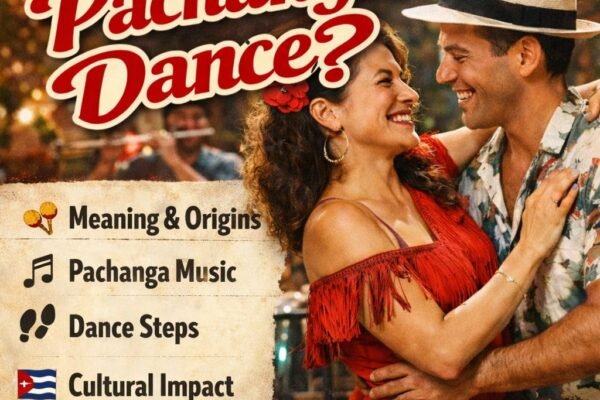
Guide to Know Everything About PachangaMeaning and Dance
Suppose you’ve ever determined yourself on a dance floor, shifting to an exciting and infectiousrhythm. In that case, the probability is that you will introduce yourself to the magic of Pachanga.Originating from Cuba, Pachanga’s meaning is more than just a dance or tune style. This isknown for its vibrant cultural expression involving pleasure, celebration, and networking. Read this blog if you’re a beginner learning dance or a track enthusiast. You’re not any of that.Let us guess. Do you love to watch and explore different cultures? Then, learn about PachangaDance’s origin and how you can experience it nowadays. What is Pachanga’s Meaning? “Pachanga” (pronounced pah-CHAHNG-gah) is a Spanish word that refers to a lively party orcelebration, especially in Latin American cultures like Cuba, Colombia, and Puerto Rico, wheremusic, dancing, and fun are central. It is also a Cuban music and dance genre that emerged inthe 1950s, blending elements of son montuno and merengue. Over time, it has come torepresent the tune and dance style that brings humans together in festive surroundings. The History of Pachanga Pachanga was first introduced by Cuban musician Eduardo Davidson in 1959, along with hismusic track La Pachanga, which quickly gained a reputation. At first, the track became famousafter being inspired by Charanga Bands, which include flutes, violins, and pianos. After mixingall these instruments, they create a gentle and playful sound. After just 1 year, Pachanga started spreading to Cuba, America, and also to Latin America. Withthis, it was getting popular, and social media was the sole reason behind its popularity. That’swhy it also became famous in the streets of New York. And yes, I just wanted to add thatPanchanga grabs its position at the golf tournament, showing joyful moves. While Salsa andother Latin rhythms eventually dominated it, Pachanga did not go away, and it is still a popularstyle among dancers and musicians worldwide. How to Dance Pachanga Dancing Pachanga is an adventurous activity that mixes techniques with free-spiritedmovement. Here are some key factors of the dance: ● Quick Footwork: The dance includes a shuffle-like motion, similar to Cha-Cha, but withmore excellent soar.● Hip Action: The fluid motion of the hips is an integral part of Pachanga, adding a playfuland flirtatious touch.● Upper Body Movement: Unlike Salsa, which frequently continues the upper bodyconsistently, Pachanga allows for expressive shoulder and arm actions.● Playfulness: Pachanga isn’t just about steps; it’s about having fun! Dancers regularlyincorporate their personal style and persona into the dance. If you’re new to Pachanga, looking at skilled dancers or taking a class is an acceptable way tolearn. Many Salsa studios offer Pachanga classes as part of their course. Pachanga in Music and Culture While Pachanga’s meaning in music is rooted in the Cuban lifestyle, it has encouraged diverseLatin American genres. Modern musicians combine Pachanga elements with Salsa, Mambo, orLatin Jazz. Pachanga music started gaining popularity from the artists Johnny Pacheco, PeteRodriguez, and Charlie Palmieri. Beyond song, Pachanga, which means “extends into cultural celebrations, ” is the essence ofmany Latin American festivals and events. Its active spirit unites human beings. The term iseven used daily to describe amusing and active collecting. Why Pachanga is Making a Comeback Recently, Pachanga has become popular among worldwide dance groups, and many Salsadancers find it difficult to learn. To make this popular, social media plays an important role, asyou can share dancing videos and tutorials that show Pachanga’s fundamental essence. Latin music’s global reputation has also encouraged a renewed interest in conventional styleslike Pachanga. As more people seek to connect with the roots of Latin dance, Pachangacontinues to gain new enthusiasts throughout generations. How to Incorporate Pachanga into Your Life If you’re enthusiastic about Pachanga and need to enjoy it firsthand, here are a few methods toget started: ● Take a Class: Look for dance studios in your area that offer Pachanga or Salsainstruction. ● Attend Latin Dance Nights: Many clubs and social occasions function Pachanga-pleasant tunes. ● Listen to Pachanga Music: Explore playlists presenting classic Pachanga songs andpresent-day diversifications. ● Host a Pachanga Party: Invite friends for an evening of tunes, dancing, and a birthdaycelebration. Conclusion Now, the Pachanga meaning is not only related to music or dance but is more related to theparty of life, movements, and networks. There’s no doubt about the delight it gives, fromdancing for the first time, rocking to the beat at a Latin club, or just soaking in the catchy beatsof Pachanga music. Now that you know the Pachanga, which means records, why not deliver ita strive? Put on some song, pass to the rhythm, and enjoy the energy of Pachanga for yourself! FAQs About Pachanga Q1: What does Pachanga mean in slang? In slang, “pachanga” refers to a wild party or a fun, chaotic celebration, often with loud music,dancing, and plenty of drinks. It’s commonly used in Latin American countries, especially inCuba, Mexico, and Puerto Rico, to describe a lively get-together or fiesta. Q2: What is Pachanga in English? “Pachanga” in English refers to a bash or a dance party with loud music, food, and friends. But italso refers to one of the Cuban dance styles. So, look at the context before finding a meaning. Q3: What is la pachanga? “La Pachanga” is a genre of music and dance that originated in Cuba in the 1950s. It ischaracterized by a lively, playful style with a strong downbeat. It is often played by charangasand features flutes, violins, horns, and drums. Q4: What does Vamos a la pachanga mean? Vamos a la pachanga is a phrase in Spanish that says, “Let’s go to the party,” as“pachanga” means a lively party or any celebration, and it is mostly used in Latin America. SeeGoogle converter is also generating the same result: Q5: What’s the difference between salsa and pachanga? Salsa is known as a broader genre of music and dance that blends mambo, cha cha cha, andmore, while Pachanga is a specific genre of dance and music known for its harder and jazziersound than other normal salsa. Q6: What kind of dance is a pachanga?…